What a great meeting I had on Monday-Tuesday at Scenario & Foresight 2018, at Warwick University, England. Besides the many insightful talks with world leading futurists and foresight researchers, I was also delighted to present my own work-in-progress at this event. That is, my case study on leveraging corporate foresight at Talent Vectia.
Setting up the scene
When I first started collaborating with Talent Vectia Oy, a year ago, only a few people were somewhat involved in foresight. We did have clear objectives, and they have not changed, but there were no structures to support them. The aim was to a) develop the organisational futures orientation of Talent Vectia, and b) to create foresight about the futures of consultancy and training business.
To be honest, we have struggled to find a way to balance with the different expectations arisen along the way. Just think – combining the roles of an ethnographic researcher with a background on human sciences, who needs time to set up the scene and to collect data before any insight can be created, and of a futurist-in-residence with expectations to act fast and to respond to so many different context dependent needs at the various levels of action, including everything from customer work and board meetings to participating in the related discussions outside the company borders.
Besides, with no previous experience on either consultancy or foresight (except the courses I took at the Finland Futures Academy in 2017, coordinated by the capable hands of Hanna-Kaisa Aalto from the Finland Futures Research Centre), this year has been quite of a journey. It has been full of exciting learning opportunities, including miss-understandings and frustrations as well as joy, laughter and pride over the results so far – for us all. That being said, I refer e.g. to the fuzz around futures related issues in the company, to the increased number of high level foresight work with customers and to the number of upcoming publications on these issues. A true process of cocreation, I would say – and I mean cocreation in terms of a a multidimensional approach to the trajectory of actions that make the value cocreation possible in practice (see Galbrun, J., & Kijima, K. (2009). Co-evolutionary perspective in medical technology: Clinical innovation systems in Europe and in Japan. Asian Journal of Technology Innovation, 17(2), pp. 195-216).
So, how have things evolved in a year?
The most important insights from this year were as follows:
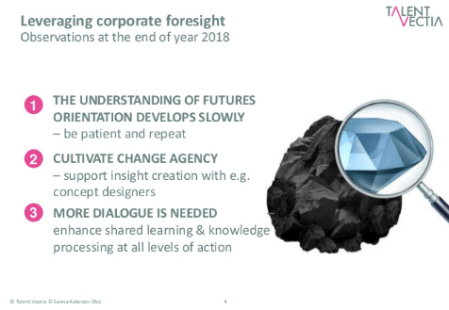
What is meant above by ‘understanding of futures orientation develops slowly’ is that, although there would be a lot of interest on futures issues, developing insightful foresight practices needs a lot of investment on the early phases of the process, to really understand what it is all about and how it should be developed in the specific context. What I personally found very functional, was the two-folded nature of change agency we cultivated this year. On one hand, myself, as a collaborator, I brought in my ideas and perspectives to be heard and discussed. On the other hand, Kati Järvi, the Head of Insight at Talent Vectia, was actively supporting this work by reminding her colleagues about our shared goals and objectives, and by helping to develop the needed structures.
Prospects for year 2019?
Beginning January 2019, I will be working as a part of a newly established group for Concept Designers. That is, as I will be an integrated part of the process where new, more futures-proof services for our clients are being developed, more futures oriented change agency will be developed in tandem. Although a lot is still to be done to be able to say that we’re strong in futures orientation, I’m so excited about this! I am certain that this also helps in creating more goal-oriented, effective futures related dialogue among the rest of our colleagues.
We have many concrete things on the duty list, e.g. continuing with the development of our company-specific futures radar at Futures Platform, and the exploration and selection of the best new futures oriented methods and tools for our needs. However, our main goal will definitely be on both developing and implementing (through experimentation!) a process that will support Talent Vectia to improve its futures orientation repeatedly, on an organised manner. As confirmed by René Rohrbeck – this is a free quote of what he said in a conversation we had at Warwick – ‘leveraging corporate foresight is actually like working as an engineer, with an aim to create a simple, but effective process at the end’.
P.S. A special thank you for my colleagues Kati Järvi, Millariia Wikman and Jarkko Pallasaho, with whom we’ve worked a lot together during this year.
 KETONENOKSI.COM
Leave a comment