This page was last updated in 2022
Futures orientation
If not before, it was at least with Covid-19 that the strategic importance of futures thinking and foresight gained a a lot of economic interest. But have things really changed? What does futures orientation actually mean? And what does it take to become more futures oriented?
I have now been working around the topic – more or less – since the end of 2017. For one thing, it has meant working as an action researcher (i.e., with hands on in insight creation and in process / practice development) in a privately owned company in the field of strategic consulting and training, The focus being on developing organisational futures orientation. Second, it has meant working as a scientist with an interest on the theoretical knowledge of applying more futures oriented practices and processes – and collecting data and information of their empirical applications. Analysing the acquired data and information. Third, it has meant working as an advisor, consulting my colleagues, peer researchers and a variety of other organisations or teams in their pursuits to work on these issues.
I have not written much from these topics, but the key learnings from developing organisational futures orientation in a strategic consulting and training company were first published in late 2020 and I have written a few highly read blogs about these things (unfortunately in Finnish). Given the many existing approaches and viewpoints for applying organisational futures orientation, my aim has been in highlighting the importance of how we think as the most essential thing to succeed in the process. Not the methods or models as such. This has been the core idea in many speeches I have held in the past years, for different audiences.
My 2-3 most recent publications on these matters will most probably be published at the end of 2023 / in 2024. In those publications, many of the ideas I have worked on throughout these years come alive, for example in the form of a framework that I have put together with my colleagues at Laurea UAS. The idea (in all of them) is to show how to build bridges between different worldviews, given the different ontological (i.e., what is the belief system that drives one’s thinking) and epistemic (i.e., how does one’s thinking relate to reality and thus make an impact with the knowledge at hand) standpoints to begin with. This is a surprisingly little studied issue thus far and therefore very interesting. It also relates strongly to what I have been working on in my previous career phases as well, non-related to futures studies.
Finally, here a summary of the IEE TEM article (pre-published in 2020):
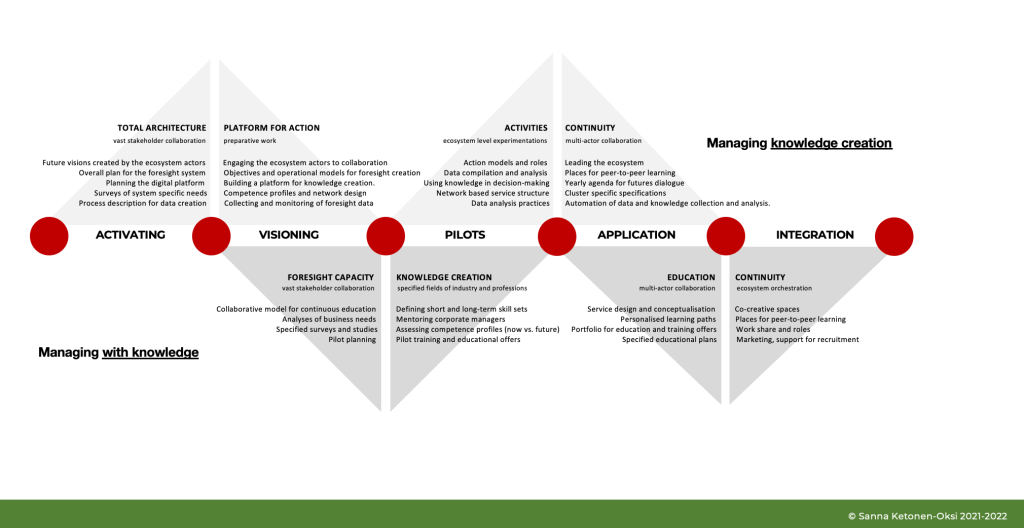
And here a figure I put together in late 2021 to show the complexity that needs to be considered when developing futures oriented practices and processes, highlighting the importance to understand the differences between the knowledge creation and knowledge management viewpoints.
 KETONENOKSI.COM