This page was last updated in 2020
Winds of change
In the early 2010s, the Finnish innovation policy was largely focused on reforming the system itself. Now, a decade later, the attention has gradually shifted towards the development of the many thematic and regional innovation ecosystems. That is, the previously prevailing technology and innovation driven approach is being replaced with the inclusive interactions among the various actors involved in the system. Both the objectives and approaches of the Finnish innovation policy have become increasingly human oriented and transparent.
At the same time, the interest in both futures thinking and the variety of methods and processes used to support strategic foresight has grown significantly. Besides acknowledging the already largely established role of foresight in the municipal sector* and in some pioneering companies, the list of futures oriented events and trainings and networks of experts has been arising. And, as stated in the latest Future Barometer**, also the public interest in futures thinking, research and decision making is steadily growing.
Both the reform of the innovation policy and the increased interest in futures thinking and foresight – whether we talk about individuals or organisations – have reflected a variety of trends (e.g. climate change, urbanisation and digitalisation), and change factors (e.g. changes in geopolitical power relationships, growing number of refugees in the EU, the transformation of labor, the crisis of capitalism, etc.), all of them being at least somewhat intertwined with one another. The increasingly challenging position of the EU (and thus also Finland) as part of the international political and economic system has added to the situation. From these starting points, e.g. The EU’s new mission-driven research and innovation policy and the EU’s Green Deal – an ambitious package of both financial support and measures to support sustainable growth.
So far, an alarmingly low number of companies have truely committed to or succeeded in developing their futures oriented capabilities, competences and skills in the long-term. In my blog on “Futures orientation – developing strategic thinking, decision-making and action“, written in January 2020, I highlighted this fact with the table below. As stated a few months later by Nando Malmelin, Matti Pihlajamaa and Pauli Komonen in our national paper on economic affairs, the mere interest in futures thinking and foresight are not enough***. Instead, more support is needed to apply the new knowledge in business development.
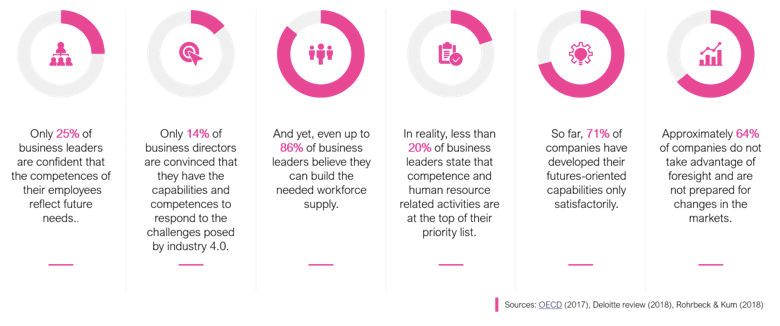
*****
Learning out from our current patterns of thinking and action
With a broad set of social and economic challenges that require increasingly systematic observation, analysis and anticipatory action to be addressed at, a call for more developed, more holistic, anticipatory systems and practices has been arousing for some time already. According to the Finnish Innovation Fund Sitra’s foresight experts Timo Hämäläinen and Katri Vataja****, this need has become even bigger since the coronavirus pandemic. But…
… as Amy Webb, an award-winning American futurist wrote recently, the benefits of strategic foresight are not limited to identifying risks, and more attention should be given to finding opportunities.
… a systemic understanding of a future operating environment builds on wholes and change rarely arises from a single factor only. It is especially true when we talk about the most unlikely and thus easily surprising factors of change.
These viewpoints bring together two recently widespread and strongly intertwined concepts: resilience (individual level) and futures orientation (organisational level). Unfortunately, those concepts don’t open up very well, or at least they don’t easily turn into action. But why? And what could we do to make them more concrete and practice-oriented?
*****
Applying a more holistic thinking
Based on my personal observations, doctrines and experiences in the fields of research, development and education, I firmly believe that our biggest challenge emerges from a combination of rootlessness (i.e. our poor knowledge of cultural history and heritage), invisibility (i.e. our inability to understand wholes), intellectual laziness (i.e. our lack of information, knowledge and wisdom), and lack of self-management (i.e. our cognitive and emotional biases). As a result, we do not see things clearly enough.
In order to succeed in the current innovation policy goals, and to thus improve the competitiveness of Finnish companies, a lot more should be invested in the long-term strategic competence development. And yet, as for now, the development of strategic competences and skills is all too often detached from the organisational strategy. Hence, attention should be paid to the following factors:
1 # Systems based attitudes and thought patterns
By this I mean understanding the interrelations between different institutional factors (e.g. shared rules, norms, meanings) and the practice of systems thinking. That is, instead of simply looking for linear cause-and-effect relationships, it is easier to find completely new types of openings through the multiplicity of viewpoints.
2 # Competences that support futures literacy
The multidimensionality and flexibility of our thinking structures play an important role in the development of futures thinking and the organisational futures orientation. In Futures orientation you’ll find my specific views on this topic.
3 # Business models and cultures that promote cocreation
Over the past decade, the ways of sharing and transmitting information have gone through a major transformation, enabling real-time customer data collection and new business opportunities. One of the main drivers of this change has been social media. With social media, we have renewed our perceptions about time (million things are done), place (where things can be done), actors (who can do what) and the connections between the actors (with whom things can be done). This, in turn, has increased the susceptibility for change in terms of how to create and share value. Instead of value chains, the interest now lies in the various, simultaneously operating value networks.
——————————————————————-
* A statement given in a recent research analysis on foresight practices in the local / municipal sector, published in Finnish, see https://www.kuntaliitto.fi/julkaisut/2020/2050-kunta-ala-ennakoijana.
** A report on how the Finnish people think about the future is published regularly in Finnish. The 2019 report can be found from here: https://www.sitra.fi/julkaisut/tulevaisuusbarometri-2019/.
*** https://www.talouselama.fi/uutiset/tebatti-yritykset-eivat-hyodynna-tulevaisuustietoa/7ad104cf-5c98-4943-8475-a0d9eb204c84 (in Finnish only)
**** https://www.sitra.fi/artikkelit/korona-paljasti-yhteiskunnan-haavoittuvuuden/ (in Finnish only)
 KETONENOKSI.COM